
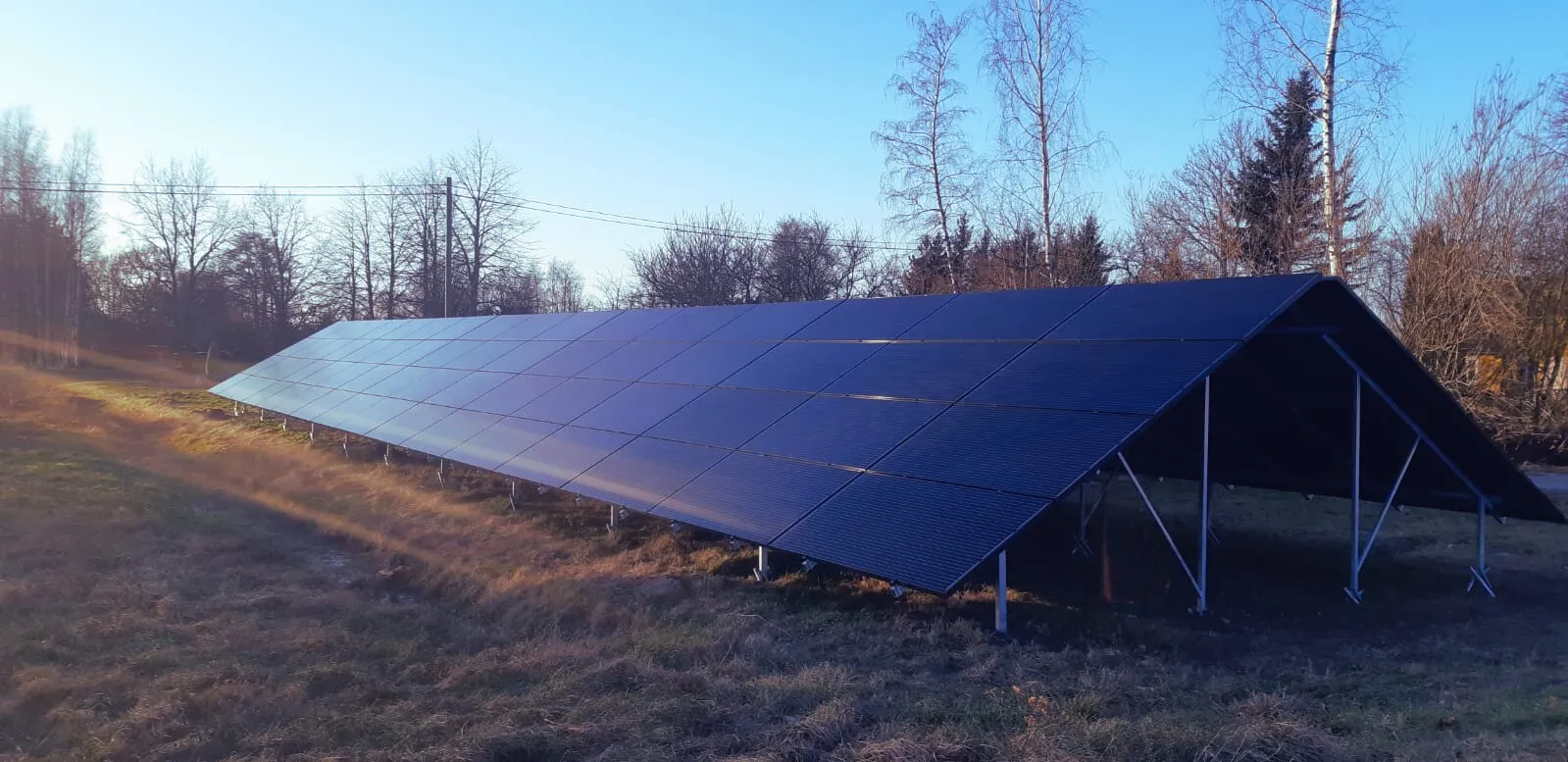
Estonia’s renewable energy plan to 2030 sets ambitious targets, providing for as much as 50% renewable energy in total energy consumption. Today the share of renewable energy is 25.6% of total consumption, almost half of the 2030 target.
Complete your ground-mounted solar system with an EV charger and use your own electricity to charge your car.
How much does a ground-mounted solar park cost?
A 15 kW ground-mounted system costs €10,940 + VAT including installation and is completed in one working day. The price does not include a battery.
The price covers panels, inverter, ground structure, cabling and electrical work. The price of larger parks is project-based — capacity, distance to the connection point and site preparation affect it most.
| Item | 15 kW ground-mounted system |
|---|---|
| Price including installation | €10,940 + VAT |
| Annual production | approx. 13,500 kWh |
| Installation time | 1 working day |
| Payback period | 6–7 years |
| Panel lifespan | over 25 years |
| Larger parks | project-based, up to megawatt scale |
We inspect the plot for free and give you a price before you order anything. See also turnkey solar park construction.
Ground-mounted or rooftop — which suits you?
Ground-mounted suits you when you have more land than roof or want higher output. Rooftop suits you when the roof surface is free and south-facing.
| Item | Ground-mounted | Rooftop |
|---|---|---|
| Price at 15 kW | €10,940 + VAT | €9,840 + VAT |
| Panel direction and tilt | Freely chosen, optimal | Depends on roof orientation |
| Output per kW | Usually higher | Depends on the roof |
| Needs free land | Yes | No |
| Limited by roof load capacity | No | Yes |
| Maintenance and snow clearing | From the ground, easy | Requires going up on the roof |
| Permits | Often a municipal procedure | Usually only grid connection |
| Later expansion | Easy if land allows | Limited by roof area |
| Largest sensible capacity | Up to a megawatt | Depends on roof area |
Read more about rooftop solar solutions. If you are unsure which suits you, we come to inspect the site and give you a price for both.
Where should a ground-mounted system be built?
In Estonia panels face south. The location is affected by shading, existing electrical infrastructure, the shape of the terrain and the distance to the connection point.
Starting the project and collecting the input data happens mainly through meetings between the customer and the installer. These clarify the customer’s wishes, options and existing requirements, and record the bottlenecks of the planned solar plant.
The choice of the right tilt and direction determines production. We also take into account the amount of solar radiation and whether you want to monitor the plant’s output in an app — monitoring lets you spot problems early.
Environmental and water-protection restrictions and the conditions for connecting to the grid also have to be considered. We review all of these together at the site visit.
At the site visit we assess:
- direction and possible tilt;
- shading from trees, buildings and lines through the day;
- terrain shape and soil load-bearing capacity;
- distance to the connection point and the underground cable route;
- environmental and water-protection restrictions;
- existing connection capacity and whether it needs increasing.
Does a ground-mounted system need a building permit?
Often yes, but not always — it depends on the municipality and the size of the plant. We clarify the need for design conditions before design, not after.
Design is needed to apply for a building permit and makes sure the plant meets both your needs and legal requirements. In design we focus on efficiency, maximum production and economic benefit: optimal direction, low system losses, maximum solar radiation and good fault tolerance.
To obtain design conditions you need to consult the building specialist of the local municipality. The application is submitted only after the necessary information has been gathered and the state fee paid.
In Estonian practice applying for design conditions is not always necessary, but you must be prepared for exceptions. Later complications arise when the need for conditions is discovered only after the main design has been submitted — which is why we clarify it right at the start.
What the design includes:
- specification of equipment, cables and connection components with quantities
- underground cable selection: load current, length, voltage class and voltage-drop limits
- cable compatibility with the chosen inverter
- documentation in the form required by the building register
MTR registration
To obtain a building permit, the company must have a valid registration in the register of economic activities (MTR). We have it — number TEL003912.
We handle design conditions, the design and the building permit for you.
What is zero export and when do you need it?
Zero export means the plant is connected to the grid but configured so that it does not sell to the grid — all production is used on site.
It is needed when the grid operator limits feed-in or when the connection agreement does not allow production to be fed into the grid. The system continuously measures consumption and reduces the inverter output as soon as production exceeds consumption — or limits the inverter’s power to match what is being consumed on site.
| Solution | Grid connection | Surplus goes | When it fits |
|---|---|---|---|
| Grid-selling plant | Yes | To the grid, for sale | When the connection agreement allows production |
| Zero export | Yes | None arises — output is limited | When selling to the grid is not allowed or sensible |
| Off-grid plant | No | Into the battery | Remote sites with no grid connection |
Zero export works best together with battery storage, or when daytime consumption is high. Otherwise part of the production simply goes unused.
When should you choose ground-mounted over rooftop?
When you have enough land, want more capacity, or the roof’s load capacity, orientation or condition sets limits.
- Free direction and tilt. Panels can be set at the optimal angle rather than following the roof — this raises output per installed kilowatt.
- Higher capacity. On the ground you can build plants up to megawatt scale, which no private-house roof can carry.
- Easier maintenance. Panels are reachable from the ground — cleaning, snow clearing and repairs do not require climbing on a roof.
- The roof does not limit you. Load capacity, age, roofing and orientation impose no limits on a ground-mounted system.
- Expandable. If consumption grows or an electric car is added, the park can be extended later if the land allows.
For larger sites see also solar park solutions for business.
How does building a ground-mounted system work?
A 15 kW ground-mounted system is completed in one working day. Before that come the site visit, design and permit process, which takes its own time depending on the municipality.
- We inspect the plot We assess direction, shading, soil, distance to the connection point and possible restrictions.
- We prepare a quote Capacity, production forecast and price — transparent, with no later extras.
- We design and apply for permits We clarify the need for design conditions, prepare the design and deal with the municipality and Elektrilevi.
- We build the park Structure, panels, inverter, underground cable and fuses according to the design and current standards.
- We connect to the grid and hand over We set up monitoring and issue the measurement protocol, documentation and warranty.
See our built ground-mounted parks.
Frequently asked questions
How much land does a ground-mounted system need?
Rule of thumb: about 2–2.5 m² per installed kilowatt when the panels are in one row and no shading occurs. A 15 kW plant therefore needs roughly 30–40 m². The spacing between rows to avoid shading adds area — we give the exact need at the site visit.
Does a ground-mounted system need a building permit?
Often yes, but it depends on the municipality and the size of the plant. We clarify the need for design conditions before design. To obtain a building permit, the company must have an MTR registration — we have it, number TEL003912.
How much does a ground-mounted system cost?
A 15 kW ground-mounted system costs €10,940 + VAT including installation and is completed in one working day. The price of larger parks is project-based — capacity, distance to the connection point and site preparation affect it most.
Does a ground-mounted system produce more than a rooftop one?
At the same capacity, usually yes, because the panels can be set at the optimal angle rather than following the roof orientation. The difference depends on how well the roof faces south — with a good south-facing roof the difference is small, with a poor orientation it is significant.
Do grass and snow get in the way of a ground-mounted system?
Grass has to be mown from under the panels so it does not shade the lower edge. Snow usually slides off tilted panels by itself, and clearing snow from the ground is in any case easier than from a roof.
Can a ground-mounted system be expanded later?
Yes, if the land and the connection capacity allow. That is why it is worth saying already at the design stage whether you plan an electric car, battery storage or higher consumption in the future — then we take expansion into account when choosing the cable and inverter.
What is zero export?
Zero export means the plant is connected to the grid but configured so that it does not sell to the grid. The system reduces the inverter output as soon as production exceeds consumption, or limits the inverter’s power to match what is being consumed on site. It is used when the grid operator limits feed-in.
Can a ground-mounted system be built on agricultural land?
It depends on the land’s designated use and the municipality’s requirements. In some cases a change of designated use is needed, in others design conditions are enough. We clarify this before we start designing.