
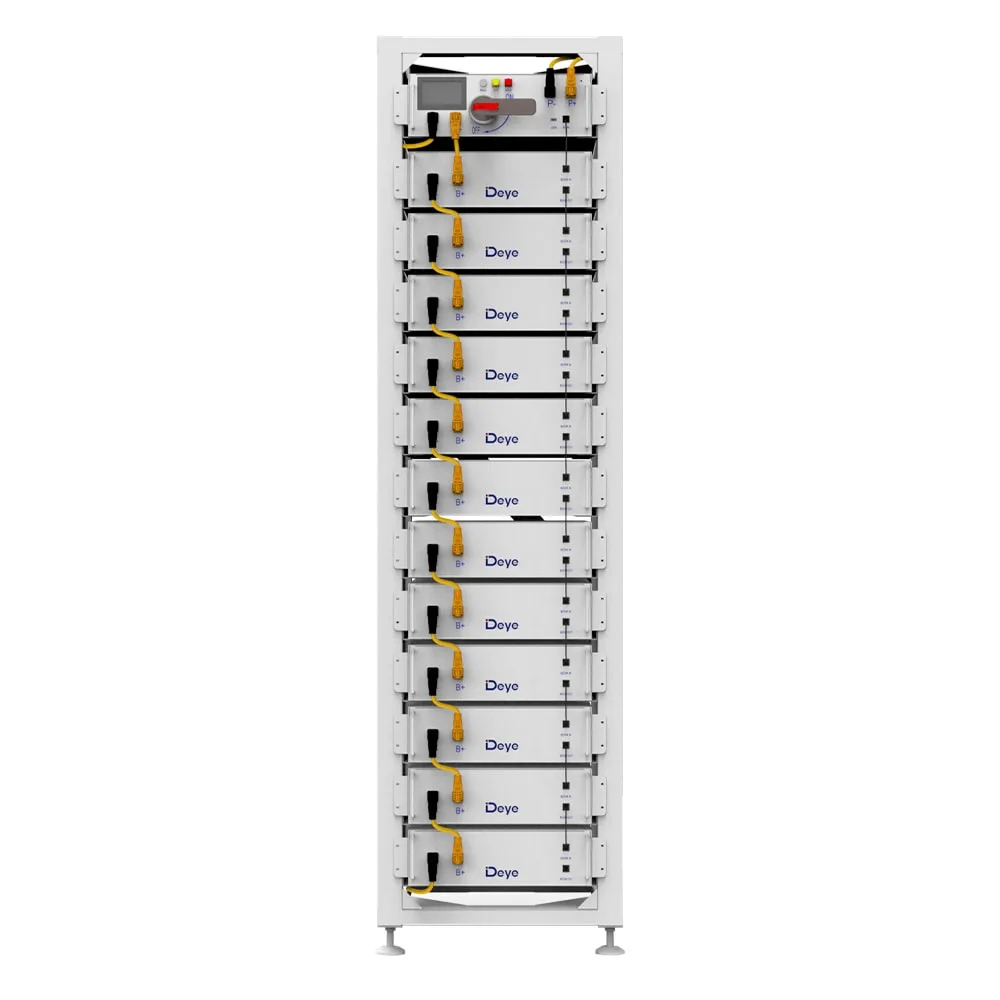
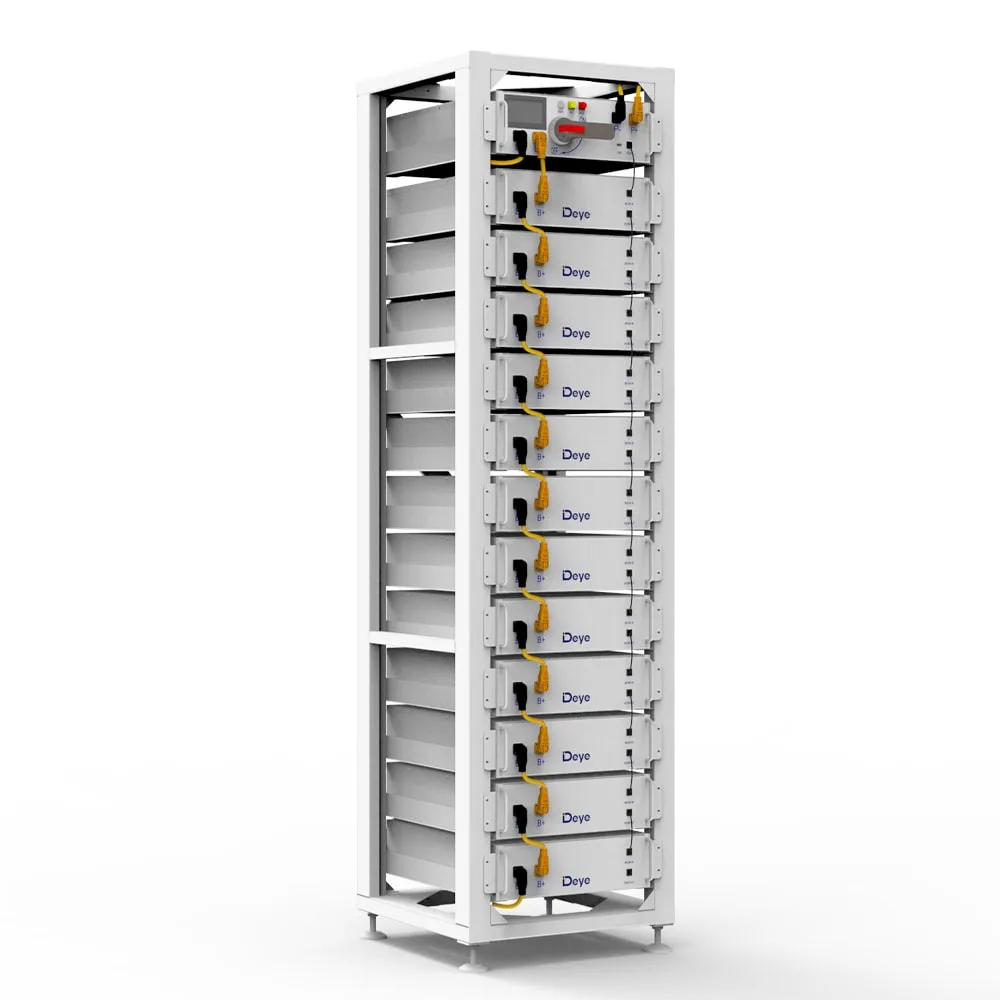
Home and small business
Deye BOS-G
20–61 kWh
- Module
- 5.12 kWh · 51.2 V · 100 Ah
- Price
- €880 + VAT per module incl. installation
- Modules
- 4–12 per rack, up to 16 racks
- Usable
- 18.43–55.29 kWh
- Dimensions
- 530 × 602 × 1629/2187 mm
Battery storage keeps the solar energy produced in the day for the evening, charges the battery at the cheap exchange price, and powers your house or production during a power cut. We install Deye BOS-G (20–61 kWh) and BOS-A (54–161 kWh) high-voltage LiFePO₄ battery systems for homes and businesses across Estonia. One 5.12 kWh battery module costs €880 + VAT including installation.
Updated · Technical data: official Deye datasheets
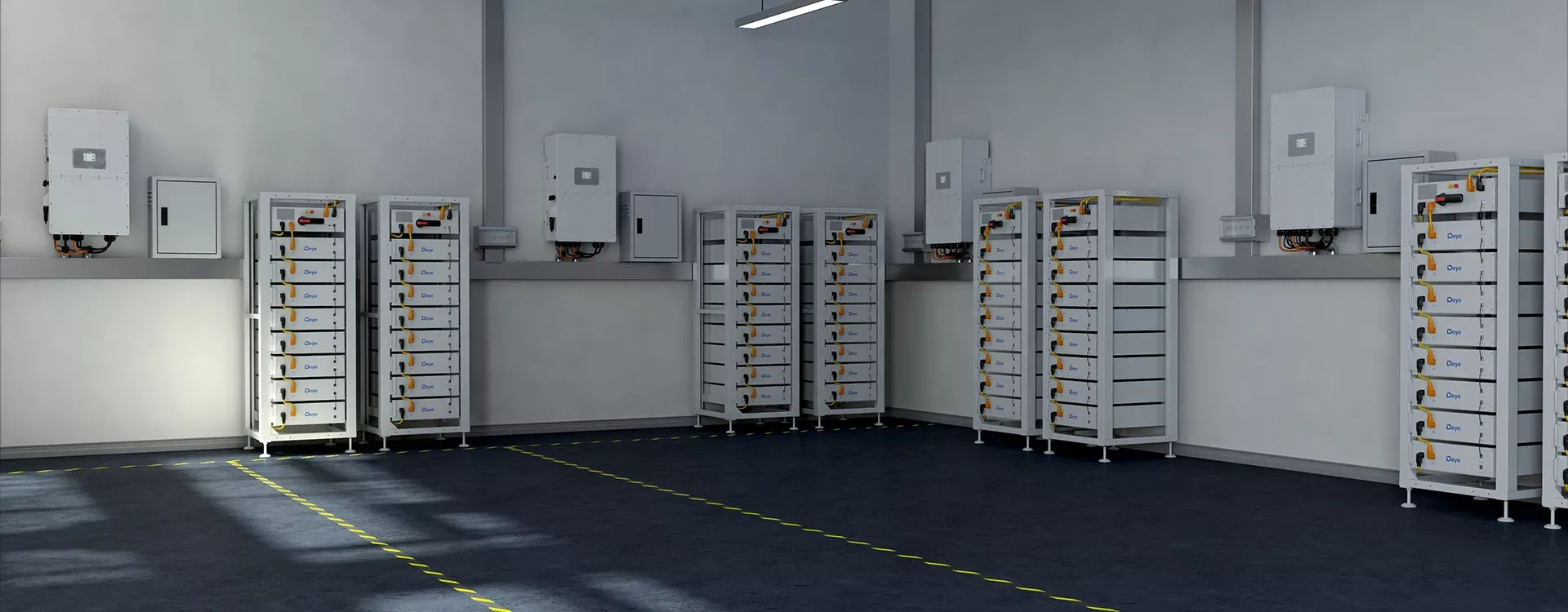
Choose BOS-G if you need 18–55 kWh of usable capacity for a home or small business. Choose BOS-A if you need 48–145 kWh in one cluster and a high charging current for industry or a warehouse.
Home and small business
20–61 kWh
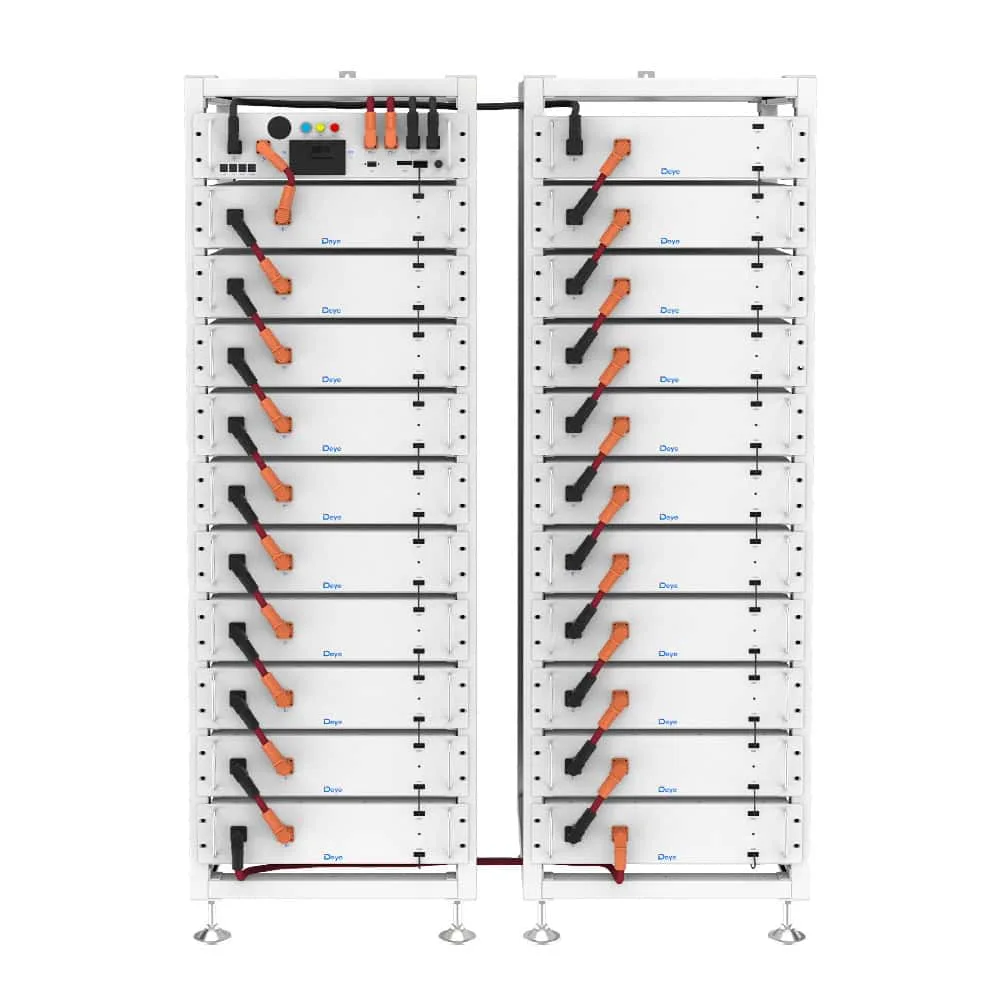
Industry and larger business
54–161 kWh
Both are high-voltage LiFePO₄ batteries with the same chemistry, cycle life and warranty. The difference is in module size, system capacity and charging current.
Best suited for
Price incl. installation
Battery chemistry
Module energy
Module nominal voltage and capacity
Module dimensions (W × D × H)
Module weight
Modules per rack
System energy
Usable energy (90% DoD)
System operating voltage
Charge and discharge current
Parallel expansion
Communication
Cycle life
Operating temperature
Storage and humidity
Installation
Warranty
Certifications
Usable energy: 90% depth of discharge, 0.2C charge and discharge at 25 °C. Cycle life: 25 ± 2 °C, 0.5C / 0.5C, down to 70% of the original capacity.
Deye BOS-G battery module (5.12 kWh) costs €840 + VAT and its installation €40 + VAT, €880 + VAT per module in total. If the battery is installed together with a solar plant, only the module price is added.
| Model | Usable capacity | Battery incl. installation | 15 kW rooftop system + battery | 15 kW ground-mounted system + battery |
|---|---|---|---|---|
| BOS-G20 | 18.43 kWh | €3,520 + VAT | €13,200 + VAT | €14,300 + VAT |
| BOS-G25 | 23.04 kWh | €4,400 + VAT | €14,040 + VAT | €15,140 + VAT |
| BOS-G30 | 27.64 kWh | €5,280 + VAT | €14,880 + VAT | €15,980 + VAT |
| BOS-G35 | 32.25 kWh | €6,160 + VAT | €15,720 + VAT | €16,820 + VAT |
| BOS-G40 | 36.86 kWh | €7,040 + VAT | €16,560 + VAT | €17,660 + VAT |
| BOS-G45 | 41.47 kWh | €7,920 + VAT | €17,400 + VAT | €18,500 + VAT |
| BOS-G50 | 46.08 kWh | €8,800 + VAT | €18,240 + VAT | €19,340 + VAT |
| BOS-G55 | 50.68 kWh | €9,680 + VAT | €19,080 + VAT | €20,180 + VAT |
| BOS-G60 | 55.29 kWh | €10,560 + VAT | €19,920 + VAT | €21,020 + VAT |
Prices exclude VAT. The solar plant price is for a 15 kW plant including installation. We give the exact price of the whole system, including the inverter and cable runs, in the quote. BOS-A price on request.
Besides Deye batteries we offer Dyness and Leapton batteries — we choose the right model based on the inverter, the capacity needed and the budget.
The model number shows the approximate capacity: BOS-G20 is 4 modules and 20.48 kWh, BOS-G60 is 12 modules and 61.44 kWh. Each extra module adds 5.12 kWh and 51.2 V.
| Model | Modules | Energy | Usable | Nominal voltage | Operating voltage | DC power | Rack height |
|---|---|---|---|---|---|---|---|
| BOS-G15* | 3 | 15.36 kWh | 13.82 kWh | 153.6 V | 124.8–175.2 V | 15.36 kW | 1,629 mm |
| BOS-G20 | 4 | 20.48 kWh | 18.43 kWh | 204.8 V | 166.4–233.6 V | 20.48 kW | 1,629 mm |
| BOS-G25 | 5 | 25.6 kWh | 23.04 kWh | 256 V | 208–292 V | 25.6 kW | 1,629 mm |
| BOS-G30 | 6 | 30.72 kWh | 27.64 kWh | 307.2 V | 249.6–350.4 V | 30.72 kW | 1,629 mm |
| BOS-G35 | 7 | 35.84 kWh | 32.25 kWh | 358.4 V | 291.2–408.8 V | 35.84 kW | 1,629 mm |
| BOS-G40 | 8 | 40.96 kWh | 36.86 kWh | 409.6 V | 332.8–467.2 V | 40.96 kW | 1,629 mm |
| BOS-G45 | 9 | 46.08 kWh | 41.47 kWh | 460.8 V | 374.4–525.6 V | 46.08 kW | 2,187 mm |
| BOS-G50 | 10 | 51.2 kWh | 46.08 kWh | 512 V | 416–584 V | 51.2 kW | 2,187 mm |
| BOS-G55 | 11 | 56.32 kWh | 50.68 kWh | 563.2 V | 457.6–642.4 V | 56.32 kW | 2,187 mm |
| BOS-G60 | 12 | 61.44 kWh | 55.29 kWh | 614.4 V | 499.2–700 V | 61.44 kW | 2,187 mm |
* BOS-G15 is in Deye's product range, but its operating voltage (from 124.8 V) falls below the 160 V limit of high-voltage hybrid inverters. In practice a high-voltage system starts at 4 modules, i.e. BOS-G20.
Rack footprint 530 × 602 mm. Up to 8 modules fit a 1629 mm rack (weight up to approx. 388 kg), 9–12 modules a 2187 mm rack (up to approx. 562 kg). Charge and discharge current: recommended 50 A, rated 100 A, peak 125 A for 2 minutes.
A BOS-A cluster has 7, 13 or 21 series-connected 7.68 kWh modules. For larger capacities up to 16 clusters are connected in parallel.
| Modules | Energy | Usable | Nominal voltage | Operating voltage | Dimensions (W × D × H) | Weight |
|---|---|---|---|---|---|---|
| 7 modules | 53.76 kWh | 48.38 kWh | 268.8 V | 235.2–306.6 V | 610 × 610 × 1900 mm | approx. 558 kg |
| 13 modules | 99.84 kWh | 89.85 kWh | 499.2 V | 436.8–569.4 V | 610 × 610 × 2350 mm | approx. 985 kg |
| 21 modules | 161.28 kWh | 145.15 kWh | 806.4 V | 705.6–919.8 V | 2 × (610 × 610 × 1900) mm | approx. 1,586 kg |
Module dimensions 601.5 × 520 × 135 mm, weight approx. 70 kg. Charge and discharge current: recommended 100 A, maximum 160 A. Installation altitude up to 3000 m.
Battery size is calculated from evening and night consumption, not from the solar plant's capacity. Add up how many kWh are used from sunset to morning, and choose a battery whose usable capacity is slightly larger.
Example: if average consumption between 5 pm and 11 pm is 2 kW, six hours use 12 kWh. Of the high-voltage systems the smallest one suits this, BOS-G20 (18.43 kWh usable). If the battery only has to cover a few kWh, a low-voltage battery is more sensible, which already works with ~5 kWh.
Suitable battery
BOS-G20
18.43 kWh usable capacity
Approximate calculation. We choose the final capacity together with the inverter power, backup circuits and consumption data.
| Situation | Recommended battery | Usable capacity |
|---|---|---|
| Small home, evening consumption under ~5 kWh | Low-voltage 48 V battery | from ~5 kWh |
| Family home | BOS-G20 | 18.43 kWh |
| Large house with a ground-source heat pump or an electric car | BOS-G25 – BOS-G30 | 23.04–27.64 kWh |
| Farm, office, small business | BOS-G35 – BOS-G40 | 32.25–36.86 kWh |
| Business with a 30–50 kW inverter | BOS-G45 – BOS-G60 | 41.47–55.29 kWh |
| Industry, warehouse, agriculture | BOS-A (7, 13 or 21 modules) | 48.38–145.15 kWh |
According to Deye, the following number of BOS-G modules is recommended for the inverter to run at full power.
| Inverter | 1 h | 2 h | 3 h | 4 h |
|---|---|---|---|---|
| Deye SUN-30K-SG01HP3-EU-BM3 | 6 modules | 12 modules | 2 × 9 modules | 2 × 12 modules |
| Deye SUN-50K-SG01HP3-EU-BM4 | 10 modules | 2 × 10 modules | 3 × 10 modules | 4 × 10 modules |
“2 × 10 modules” means two racks connected in parallel, each with 10 modules.
A battery pays for itself best when a large part of the solar production would otherwise go cheaply to the grid. On self-consumed electricity you pay no electricity price, grid fee or renewable energy charge.
The midday surplus goes into the battery, not cheaply to the grid. In the evening you use your own electricity and pay no electricity price, grid fee or renewable energy charge for it.
A Deye hybrid inverter charges the battery in up to six time periods a day — in during cheap hours, out to consumption during expensive hours.
In a power cut the battery keeps selected circuits running. The switchover time of the Deye SUN-50K hybrid inverter is under 10 ms.
In a business the battery covers short consumption peaks, so the connection capacity does not have to be increased for them.
A battery works best together with an asymmetric hybrid inverter, which directs power to the phase where the consumption is and avoids netting losses. Read more about hybrid inverters or see how an EV charger uses solar and battery energy first.
LiFePO₄, or lithium iron phosphate, is the most common chemistry for stationary battery storage: it is thermally stable, contains no cobalt and withstands thousands of charge cycles.
≥ 6000
charge cycles down to 70% capacity
90 %
recommended depth of discharge
10 yrs
manufacturer warranty
At one full cycle a day, 6000 cycles theoretically corresponds to more than 16 years. The battery management system (BMS) balances the cell voltage and protects against overcharge and over-discharge, overcurrent and temperature extremes. Self-discharge is low and there is no memory effect.
Both are high-voltage batteries, so you need a high-voltage hybrid inverter whose battery voltage range covers the battery's operating voltage.
| Inverter | Battery voltage | Fits by voltage |
|---|---|---|
| Deye SUN-5…20K-SG01HP3-EU-AM2 | 160–700 V | BOS-G20 to BOS-G60 |
| Deye SUN-50K-SG01HP3-EU-BM4 | 160–800 V, 2 battery inputs, 50 A + 50 A | BOS-G20 to BOS-G60, BOS-A 7 and 13 modules |
The lower operating voltage of BOS-G15 (124.8 V) falls below the 160 V limit of these inverters, which is why a high-voltage system starts at 4 modules. The 21-module BOS-A (up to 919.8 V) exceeds the 800 V limit — for it we choose a suitable inverter separately. We check final compatibility against Deye's compatibility list.
A battery needs a dry indoor room above freezing, a floor with sufficient load-bearing capacity and a qualified electrician, because the system voltage reaches hundreds of volts.
Protection class IP20 and humidity 5–85% RH. A utility room, a dry basement or a heated garage suit. For outdoor installation you need a heated cabinet or utility building.
Charging 0…55 °C, discharging −20…55 °C, storage 0…35 °C. In a cold shed the battery would not charge in winter.
A full BOS-G rack weighs up to approx. 562 kg on 0.32 m² — roughly 1.8 t/m². A 13-module BOS-A weighs approx. 985 kg. We check the floor before installation.
BOS-G rack 530 × 602 mm, height 1629 or 2187 mm. BOS-A cluster 610 × 610 mm, height 1900–2350 mm.
High-voltage DC work is done only by a qualified electrician. We have a registration in the register of economic activities, TEL003912, and over 14 years of experience in electrical work. If the building has no suitable room, we install the batteries outdoors in an insulated battery house.
BOS-G and BOS-A are CE-marked and tested to international battery safety standards.
Payback depends on three things: how much of the solar production would otherwise go cheaply to the grid, how big the exchange-price difference is between cheap and expensive hours, and whether you need backup power. We calculate the payback from your consumption data before giving a quote.
Deye BOS-G and BOS-A withstand at least 6000 charge cycles (25 °C, 0.5C), after which at least 70% of the original capacity remains. At one cycle a day that is theoretically over 16 years. The warranty covers 6000 cycles or 10 years, whichever comes first.
BOS-G is made of 5.12 kWh modules and ranges from 20.48 to 61.44 kWh — it suits a home and a small business. BOS-A is made of 7.68 kWh modules and ranges from 53.76 to 161.28 kWh in one cluster — it is meant for industry and larger business.
Yes. A battery can also be added to a plant installed years ago, either by replacing the inverter with a hybrid one or with AC coupling, keeping the existing inverter. Which makes more sense becomes clear when we inspect the panel and the inverter.
Yes. A BOS-G rack holds up to 12 modules and up to 16 racks can be connected in parallel. A BOS-A cluster has 7, 13 or 21 modules and up to 16 clusters can be paralleled. We recommend planning the rack size right at the start so that expansion is easy.
The batteries are meant for indoors: the protection class is IP20 and they can be charged at 0…55 °C. Suitable places are a utility room, a dry basement or a heated garage. For outdoor installation you need a heated cabinet or a heated utility building.
Yes, if it is connected to a hybrid inverter with backup output. The battery then keeps the selected circuits running. The switchover time of the Deye SUN-50K hybrid inverter is under 10 ms, so most devices do not notice the outage.
Yes. In a Deye hybrid inverter you can set up to six charging and discharging periods a day, and the Deye Cloud platform has an extra option for control by dynamic tariff.
A Deye BOS-G battery module (5.12 kWh) costs €840 + VAT and its installation €40 + VAT, €880 + VAT per module in total. The smallest high-voltage system, BOS-G20 (4 modules, 20.48 kWh), therefore costs €3,520 + VAT. We give the exact price including the inverter and cables in the quote.
If the battery is installed together with the solar plant, only the price of the battery modules is added, €840 + VAT per module. For example, a 15 kW rooftop system with a BOS-G20 battery costs €9,840 + €3,360 = €13,200 + VAT.
A high-voltage system only starts working from 4 modules, about 20 kWh (BOS-G20). If you do not need such a large battery, a low-voltage system (48 V) suits you, which already works with a single battery of about 5 kWh.
We offer original Deye batteries Deye BOS-G and BOS-A, and also Dyness and Leapton batteries. We choose the right battery based on the inverter, the capacity needed and the budget.
Installing one battery module takes about 15 minutes. If the battery is installed together with a solar plant, the whole system is ready within the same working day.
We inspect the panel and the existing plant, calculate the right battery capacity and payback, and install the whole system. We work across Estonia.