
Battery houses — an insulated solution for battery storage
We install insulated technical houses for battery storage, so the batteries can sit in a separate, protected environment outdoors. The solution suits solar parks, businesses and sites with higher energy consumption.
- A real installed solution
- Deye battery modules
- Designed to the site
Insulated
A separate technical environment built around the batteries.
Outdoors
Battery storage does not have to take up space inside your building.
Protected
Equipment is protected from weather and the direct outdoor environment.
Project-specific
The solution is adapted to the battery bank, the inverter and the site.
From one place
Electrical work, battery storage and system control from one installer.
The Amper ja Volt battery house — a real solution
We do not treat battery storage as merely installing a battery. We design the whole solution: the battery location, the technical environment, electrical connections, the inverter, control and system commissioning.
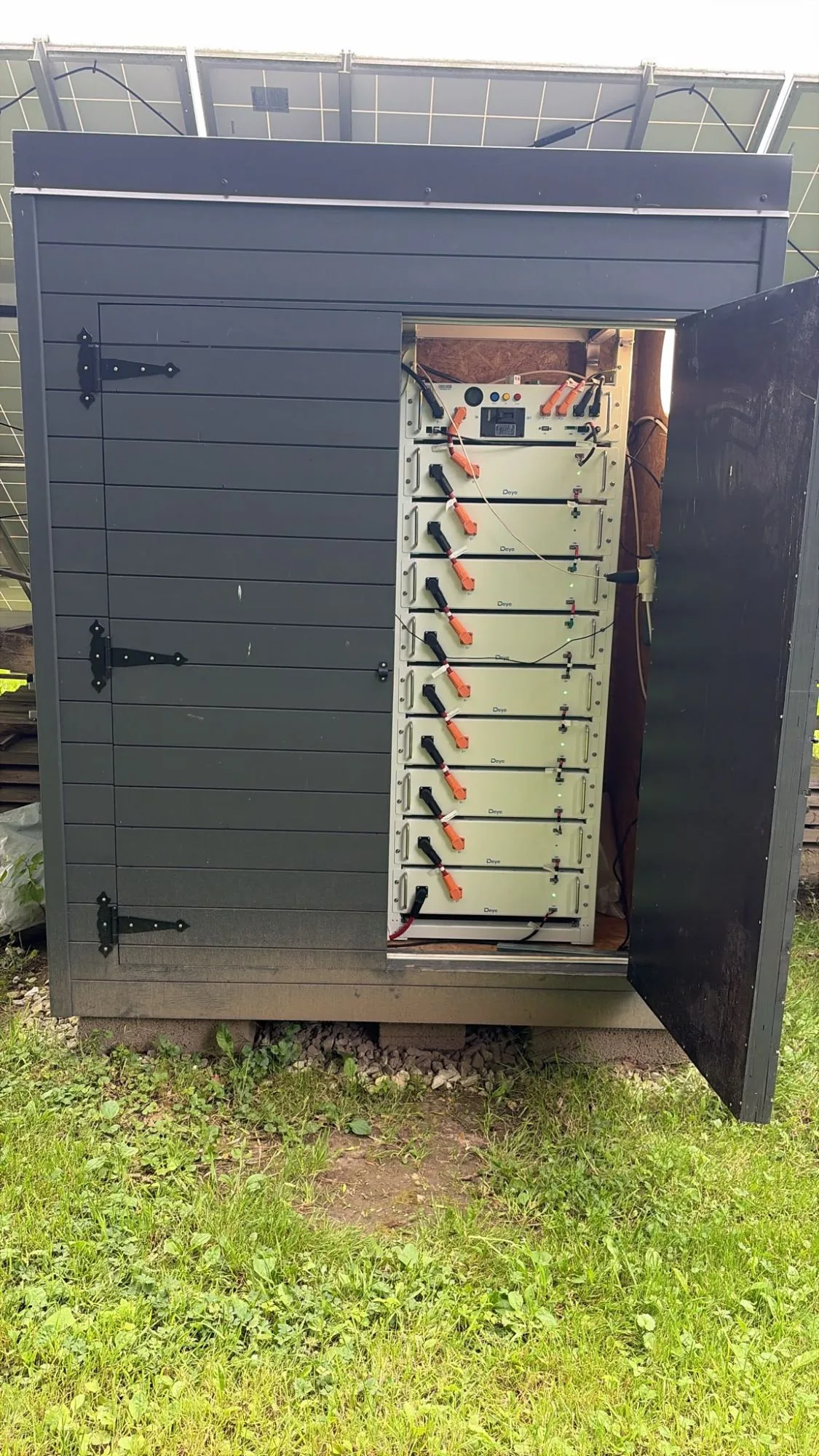
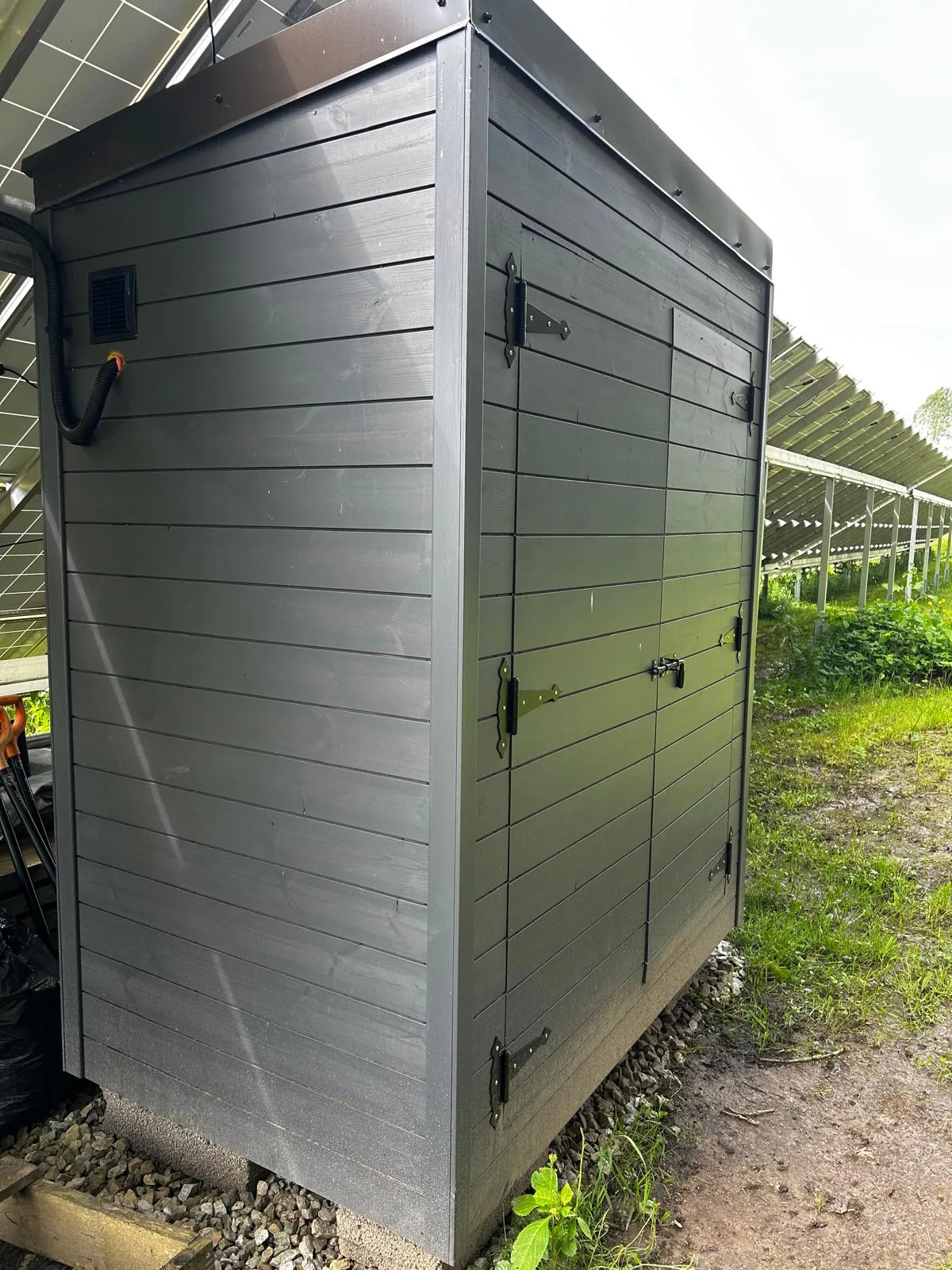
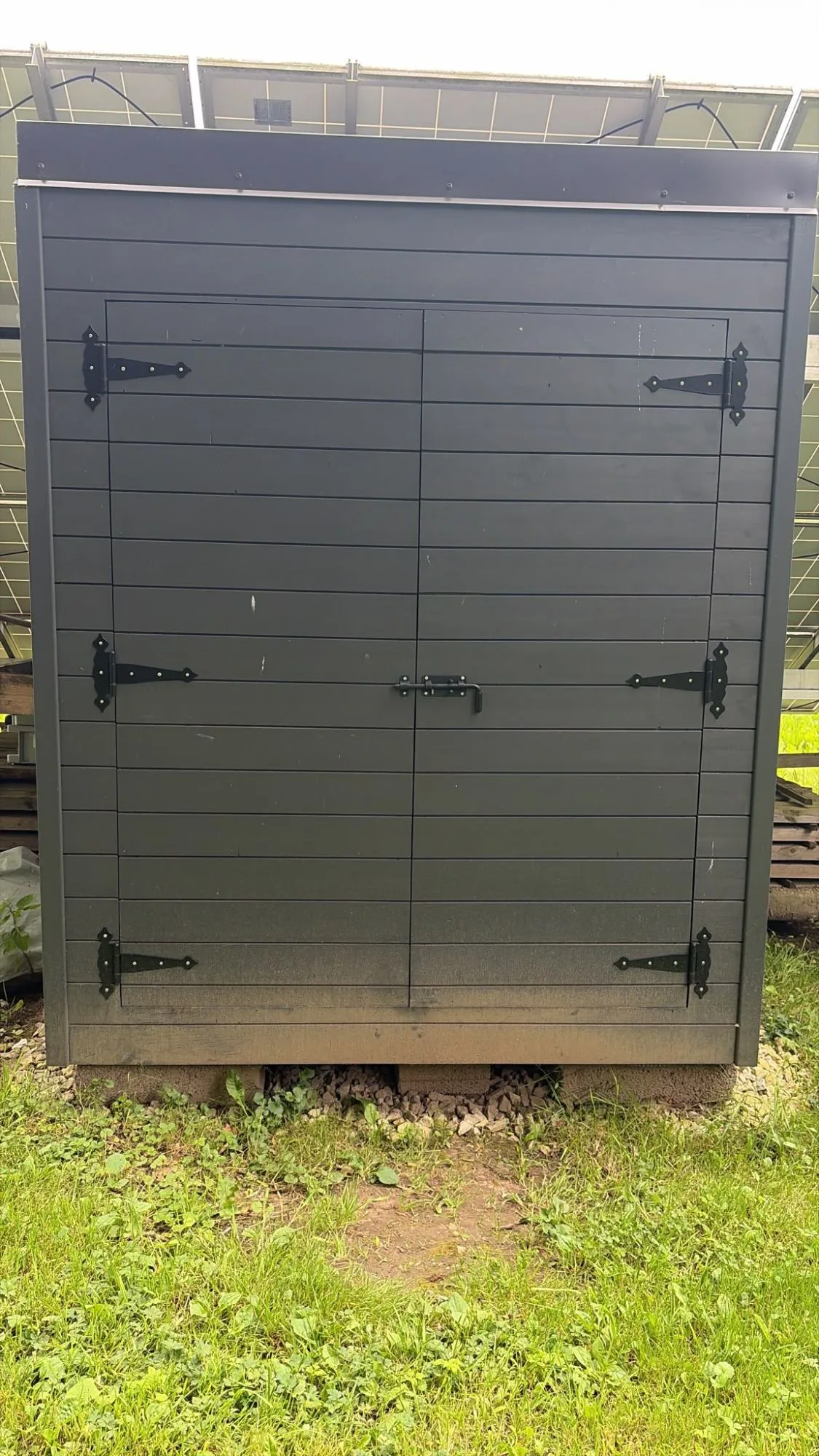
The photos show our installed battery house in a solar park setting: from outside, from the front and with the door open, so the Deye battery modules are visible. The exact solution, dimensions and equipment are chosen for each site separately.
What is a battery house?
A battery house is an insulated technical house that holds the battery modules of a storage system and the equipment connected to them, so they are protected from the weather and located separately from your building.
It is not an ordinary shed or container. A battery house is an outdoor technical room built for battery storage, in which the battery environment, electrical connections, service access and, where needed, ventilation can be solved. The whole solution is designed for the specific battery bank and site.
A battery house combines well with our Deye BOS-G and BOS-A battery storage and hybrid inverters.
Why install the batteries in a separate battery house?
A battery house lets you place battery storage in a separate protected technical room, where the battery temperature environment, ventilation, electrical connections and service access can be solved according to the needs of the specific system.
Weather protection
The batteries and their connections are not directly exposed to rain, snow or wind.
Temperature environment
Lithium batteries need a defined operating temperature. An insulated room helps maintain that environment, but the solution needed (for example heating or ventilation) depends on the project.
Protection from direct sun
The batteries are not left in direct sunlight.
Controlled access
A lockable technical room limits access and makes servicing clear.
Physical protection
Equipment sits in a separate structure, not freely outdoors.
Separate from the building
Battery storage can be located apart from the building, keeping indoor space free.
Close to the solar park
Batteries can be placed near the solar park or the inverter rather than inside a building.
A battery house alone does not solve every battery storage safety requirement. Fire safety, distances, ventilation and connections are solved separately on each site and in line with the requirements in force.
How does a battery house work with battery storage?
A battery house is part of a complete energy system: solar panels produce, the inverter manages, the battery stores and the building, business or electric car uses.
- SunEnergy source
- Solar panelsProduce
- InverterManages
- Battery houseStores
- Building / EVUses
Solar energy produced during the day that the building does not consume right away can be directed into the battery and used later — for example in the evening or during higher consumption. Exactly how the system works depends on the inverter, its settings and the battery bank.
What does a battery house contain?
Open the door and look inside. The photo shows Deye battery modules installed in a rack inside the battery house. The additional equipment depends on each project.
Visible in the photo
- 1Control unit. The control unit with indicator lights on top of the battery rack
- 2Battery modules. Deye battery modules in a rack (Deye marking visible)
- 3Double door. The opening double door in front of the technical room
Only components that can be reliably identified in the photo are labelled. The exact equipment, cabling and monitoring are chosen per project.
Who is a battery house for?
A battery house suits situations above all where there is no suitable indoor room for battery storage or where you want the batteries near the solar plant.
Home
For a larger home system when the building lacks suitable space.
Business
For commercial sites with higher energy consumption.
Solar park
For outdoor battery storage next to solar production.
Farm and production
For sites where electricity consumption is large or variable.
EV charging
For sites where battery storage and charging are combined.
A battery house for a solar park
Next to a solar park, a battery house lets you store the daytime production and use it when it is needed.
- storing daytime solar production
- increasing self-consumption
- shifting energy use in time
- reducing dependence on the grid
- supporting larger electrical loads
- combining with EV charging
We do not promise specific savings. The economic benefit depends on system size, consumption, electricity price, grid connection, battery capacity, solar production and how the system is operated. See also our ground-mounted and rooftop solar solutions.
A battery house for business
For a business, a battery house lets you place battery storage outside the building and connect it with solar energy, the building's consumption and the inverter.
- manufacturing and warehouses
- offices and commercial premises
- farms
- solar power plants
- properties with higher electricity consumption
Possible extras such as EV charging or energy management depend on the system and equipment. Not every configuration supports every function. See also solutions for business.
A battery house and EV charging
Solar energy can be stored in the battery and used later for consumption, including EV charging, when the system is designed for that.
- SunProduces
- Battery houseStores
- Electric carCharges
A battery house does not charge an electric car by itself: that needs a suitable charger, inverter and configuration. See our EV chargers (VOOL and Deye).
How does a battery house solution come together?
The work normally follows the steps below. In a specific project the order and content can differ.
- Assessing the site and consumptionWe look at the site, the existing electrical system and energy consumption.
- Determining the storage needWe choose the size and type of the battery bank according to consumption and goal.
- Designing the house and equipmentWe design the technical house and the equipment layout.
- Planning the electrical and control systemCabling, fuses, monitoring and control.
- Installing the battery housePlacing the technical house on site.
- Installing batteries and invertersInstalling the battery modules, the inverter and the connections.
- ConfigurationSetting up and testing the system.
- CommissioningHanding over the system and instructing the user.
Not every project follows exactly these steps, because site requirements can differ.
Batteries in a building or in a separate battery house?
The right solution depends on the project. A battery house is not always the better choice, just one option.
| Item | In a building | In a battery house |
|---|---|---|
| Location | Indoors | A separate technical house |
| Indoor space needed | More | Less |
| Outdoor conditions | Depends on the room | A solution for outdoor conditions |
| Service access | Inside the building | A separate technical room |
| Location flexibility | Limited | Greater |
| Solar park | Depends on the site | Very suitable |
The table is a general comparison, not data on a specific product.
Technical data
We list only data that is confirmed. Other figures depend on the specific solution.
| Item | Value | Status |
|---|---|---|
| Construction | Technical house with wooden cladding and a metal roof, double door (visible in the photos) | Confirmed |
| Insulation | Insulated; thickness and solution project-specific | Project-specific |
| Dimensions | Project-specific | Project-specific |
| Battery type | Deye battery modules (visible in the photo); model and capacity chosen per project | Project-specific |
| Battery capacity | According to the battery bank | Project-specific |
| Inverter | A Deye hybrid inverter or another suitable solution | Project-specific |
| Ventilation | A ventilation grille is visible in the photo; solution project-specific | Project-specific |
| Heating and cooling | According to the project | Project-specific |
| Electrical connections | According to the project | Project-specific |
| Monitoring | According to the equipment and configuration | Project-specific |
| Fire safety | Solved in the design according to the requirements in force; no fire class is confirmed | Needs confirmation |
| Service access | Opening door into the technical room | Confirmed |
We give exact information on dimensions, insulation, fire safety and other figures in the quote.
General battery information (not battery house data)
According to the Deye BOS-G and BOS-A datasheets, the batteries have protection class IP20 (for indoor use), a charging temperature of 0…55 °C and a discharge temperature of −20…55 °C. That is why batteries installed outdoors need a suitable protected and, where needed, heated environment. See the battery storage page for details.
Frequently asked questions
What is a battery house?
A battery house is an insulated technical house in which the battery modules of a storage system and the equipment connected to them are placed, so they are protected from the weather and located separately from the building.
Why install batteries in a separate house?
A separate battery house saves indoor space in the building, lets you place the batteries near the solar park and creates a protected technical environment for the batteries with service access. Whether it is the best solution depends on the project.
Is a battery house suitable for the Estonian climate?
A battery house is meant for outdoor conditions and is insulated. Deye batteries may be charged at 0…55 °C, so an outdoor installation needs a protected and, where needed, heated environment. We choose the specific insulation and heating solution per project.
Can Deye batteries be installed in a battery house?
Yes, the battery house we installed contains Deye battery modules. We choose the specific model and capacity per project. See Deye BOS-G and BOS-A battery storage.
Can a battery house be connected to solar panels?
Yes, a battery house is meant to be part of a solar energy system. The connection is designed together with the panels, the inverter and the cabling.
Can a hybrid inverter be connected to a battery house?
Battery storage works together with a suitable hybrid inverter. Whether the inverter is placed inside the battery house or elsewhere depends on the project. See the hybrid inverters page.
Is a battery house suitable for a business?
Yes, a battery house suits businesses and higher-consumption sites where battery storage should be placed outside the building. The solution is chosen according to consumption and goal.
Is a battery house suitable for a solar park?
Yes, next to a solar park an outdoor technical house is one sensible way to place battery storage. See also our ground-mounted solar solution.
Can a battery house be connected to an EV charger?
Battery storage can also support EV charging when the system is designed for it. A battery house does not charge a car by itself. See our EV chargers.
Can a battery house be made in different sizes?
The solution is adapted to the needs of the battery bank and the site. We discuss exact dimensions and options during the quote.
Related solutions
- Battery storage — Deye BOS-G and BOS-A batteries
- Ground-mounted solar — Ground-mounted solar park
- Rooftop solar — Solar panels for roofs
- Hybrid inverters — Energy management
- EV chargers — VOOL and Deye
Do you need a separate battery house for battery storage?
Describe your site, your energy consumption and the battery storage solution you want. We assess your needs and help you choose a suitable battery house, battery bank, inverter and control solution.