
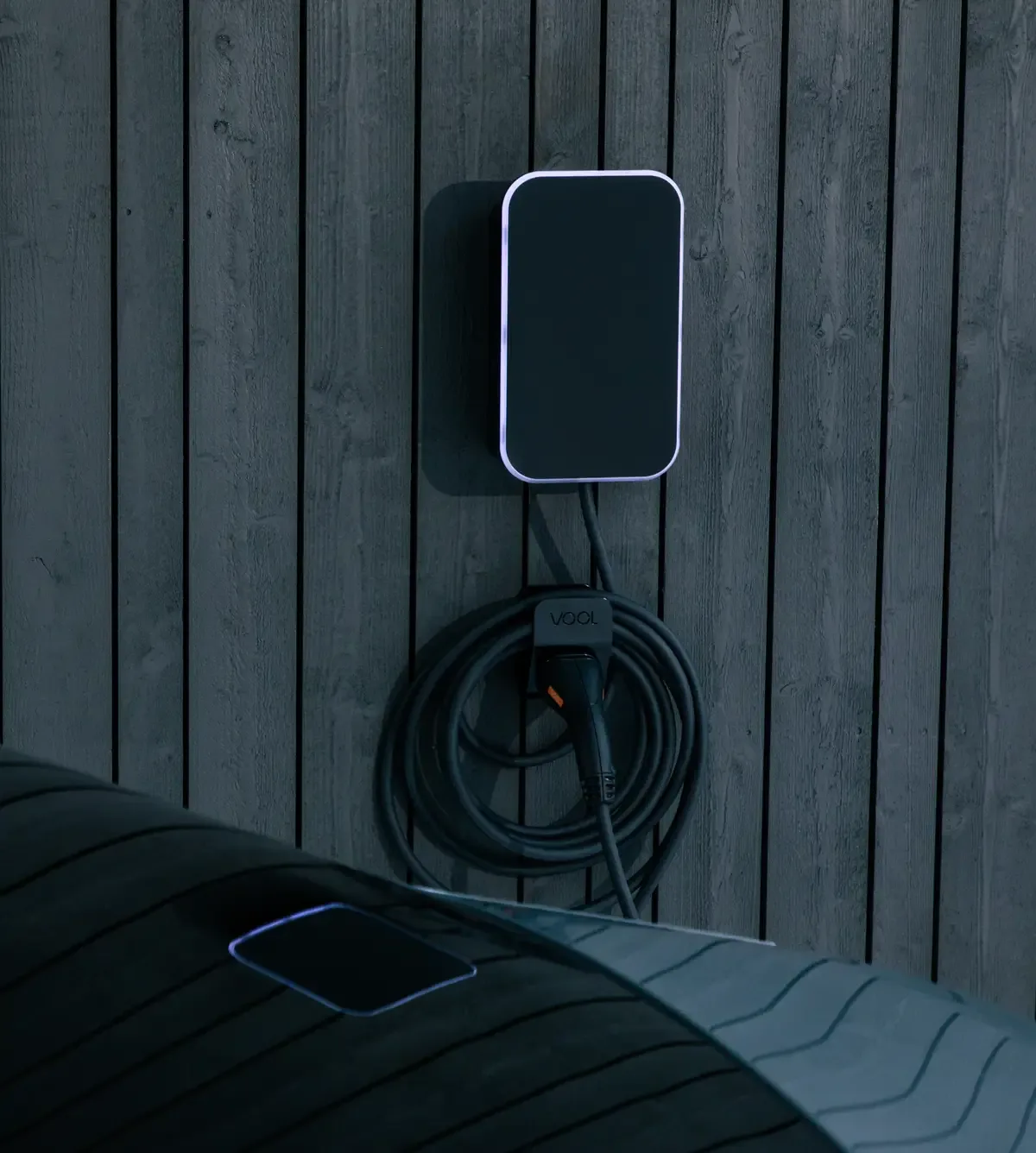
We also install rooftop solar panels and ground-mounted solar plants, which together with the charger give the biggest savings.

Related services and solutions
An EV charger saves the most together with a solar plant and battery storage — we install the whole system from one place.
- Rooftop solar — solar panels on the roof that also power the charger
- Ground-mounted solar — a ground-mounted solar plant for larger production needs
- For homes — a complete home solution: panels, batteries, charger
- For business — company charging solutions and solar parks
Which EV charger should you choose?
For most Estonian private houses the best choice is an 11 kW AC charger, which usually needs a 3 × 16 A electrical connection. If you want higher charging power or want to prepare for future electric cars, choose a 22 kW AC charger.
The three most important factors when choosing a charger:
- your existing electrical connection;
- the maximum AC charging power of your electric car;
- your future energy needs.
Charger power and required electrical connection
| Charger power | Suitable for | Required electrical connection |
|---|---|---|
| 11 kW AC | Most private houses | 3 × 16 A |
| 22 kW AC | Homes and businesses with higher charging needs | 3 × 32 A |
11 kW charger
- Suits most Estonian private houses.
- Usually needs a 3 × 16 A electrical connection.
- Most electric cars sold in Europe support AC charging up to 11 kW.
22 kW charger
- Suits buildings with a 3 × 32 A or larger electrical connection.
- Allows faster AC charging for vehicles that support 22 kW charging.
- Can also be installed in a building with a smaller main fuse, with the charging power limited in software. If the electrical connection is upgraded in the future, the same charger can be used at full power.
Good to know: a 22 kW charger can also be installed in a building with a 3 × 16 A connection. In that case the charging power is limited in software to match the main fuse. If the connection is increased in the future, the same charger can be used at full power without buying a new unit.
All chargers installed by Amper ja Volt Solarworks use the European standard Type 2 connector, which is compatible with virtually all electric and plug-in hybrid vehicles sold in Estonia.
How long does it take to charge an electric car?
A 22 kW charger charges a 60 kWh battery in about 3 hours, an 11 kW charger in about 6 hours.
Charging speed depends on the battery size and the car’s built-in AC charger.
Charging time from empty to full
| Battery size | 11 kW charger | 22 kW charger* |
|---|---|---|
| 40 kWh | about 4 hours | about 2 hours |
| 60 kWh | about 6 hours | about 3 hours |
| 77 kWh | about 7–8 hours | about 4 hours |
* If the vehicle supports 22 kW AC charging. Most electric cars support up to 11 kW.
How does smart EV charging reduce your electricity bill?
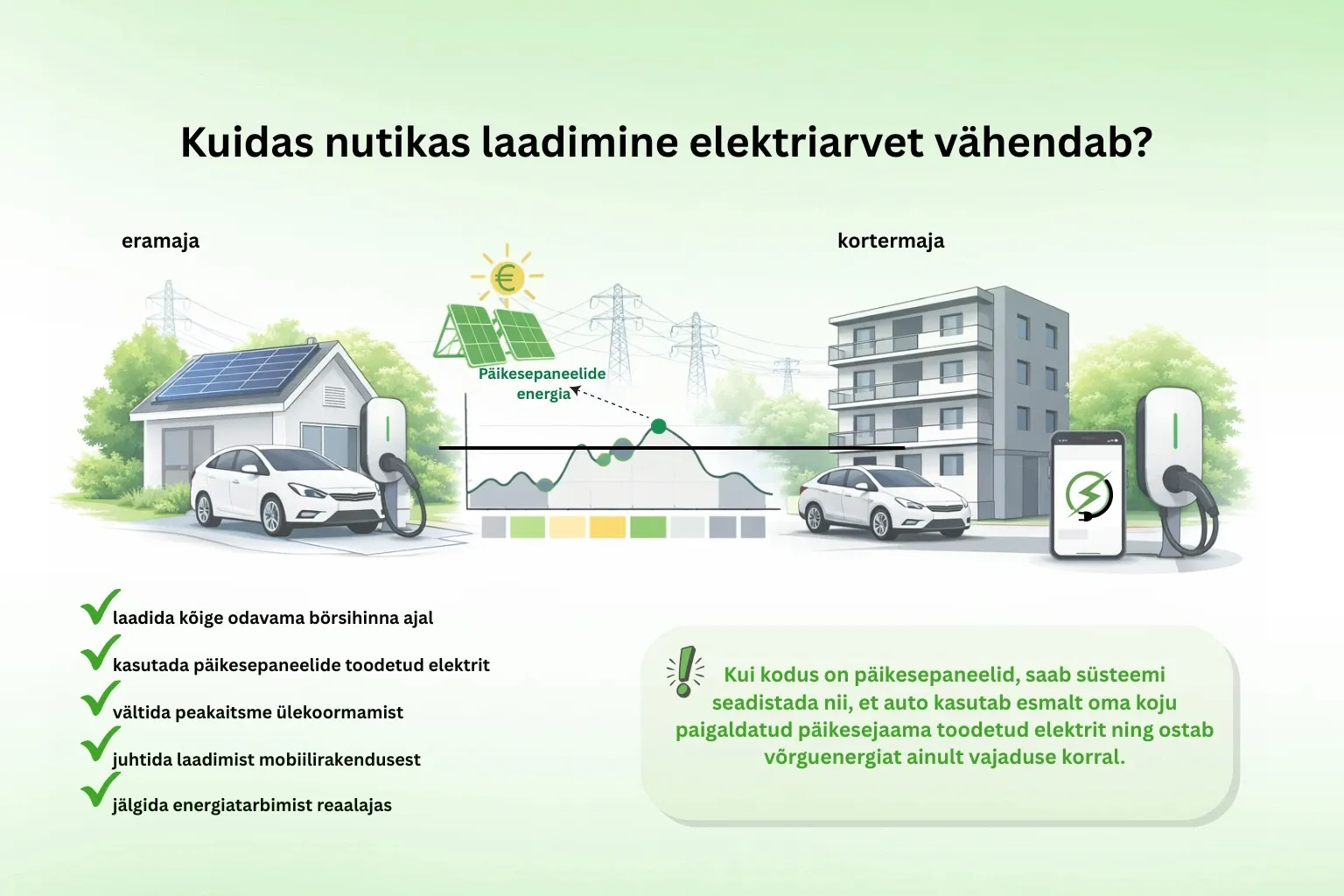
A smart EV charger charges at the cheapest exchange price and uses the electricity produced by your solar panels first.
Charging an electric car does not have to happen right after you get home. A smart charger lets you:
- charge at the cheapest exchange price;
- use electricity produced by solar panels;
- avoid overloading the main fuse;
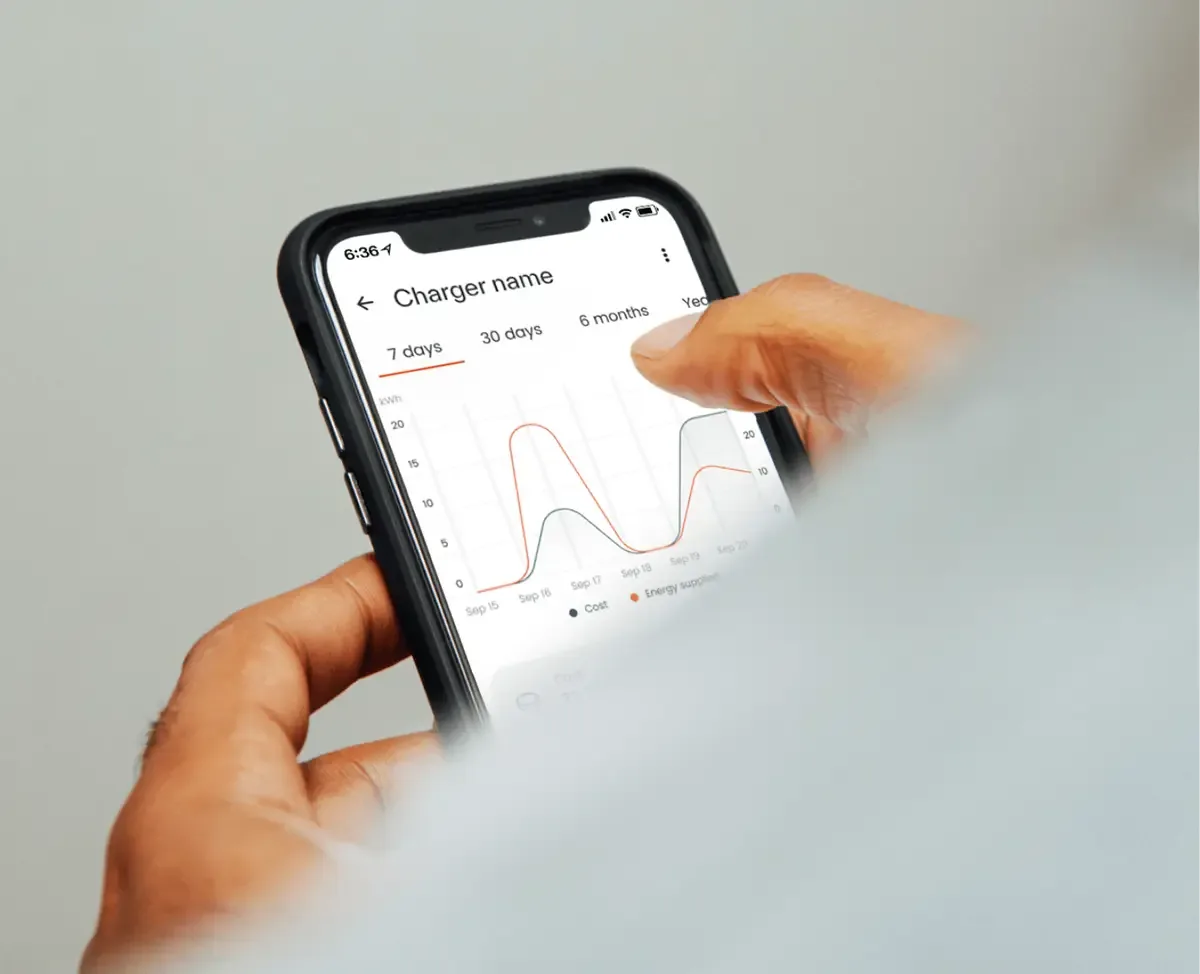
- control charging from a mobile app;
- monitor energy consumption in real time.
If your home has solar panels, the system can be set up so that the car uses electricity from your home solar plant first and buys grid energy only when needed.
The VOOL App detects the exchange price automatically and charges the car at the cheapest time. According to VOOL, charging is 30% cheaper on average this way.
VOOL or Deye — which charger to choose?
- Choose VOOL if you want a standalone smart charger.
- Choose Deye if you already use a Deye hybrid inverter.
VOOL and Deye EV charger comparison
| Feature | VOOL | Deye |
|---|---|---|
| Charging power | up to 22 kW AC | 11 / 22 kW AC |
| Connector | Type 2 | Type 2 |
| Phases | 1-, 2- and 3-phase* | 1- and 3-phase |
| Charging cable | 6.5 m | 4.2 m |
| Protection class | IP55 · IK10 | IP66 |
| Operating temperature | −25 °C to +65 °C | −40 °C to +55 °C |
| Connectivity | 4G, WiFi, Bluetooth, Ethernet | LoRa, WiFi, Bluetooth (BLE) |
| OCPP support | OCPP 1.6 and OCPP 2.0.1 | Not stated by the manufacturer |
| Load sharing between several chargers | Yes, automatic Dynamic Load Management | Not stated by the manufacturer |
| Built-in DC leakage protection | 6 mA DC + 30 mA AC residual current detection | 6 mA DC |
| Charging from solar surplus | Yes | Yes, automatic with a Deye hybrid inverter |
| Best suited for | Home, housing association, business, public charging points | Deye hybrid inverter users |
* The VOOL charger supports 1-, 2- and 3-phase connections. Check the number of phases in your electrical panel before choosing a charger.
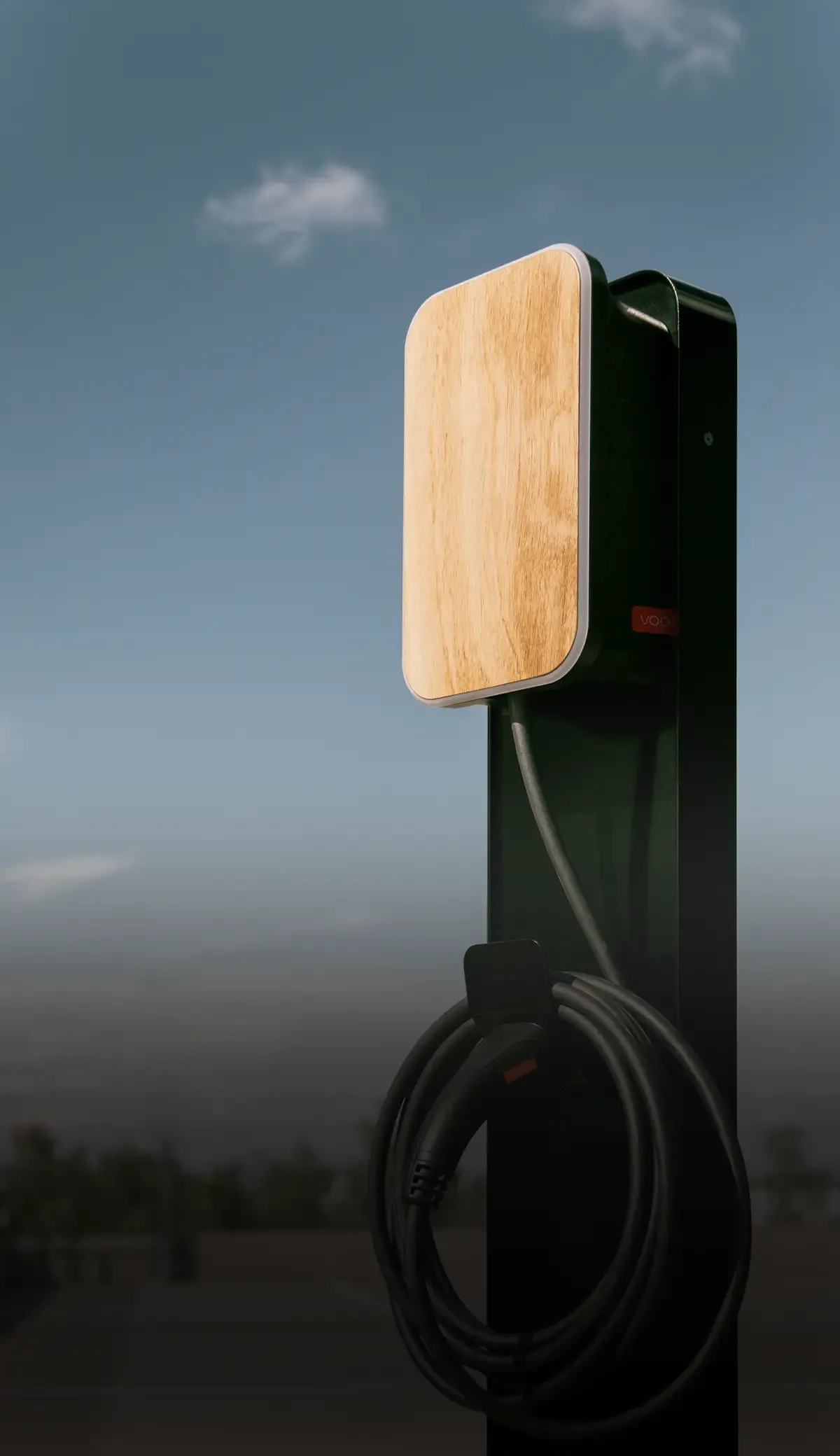
VOOL EV chargers
A smart charger developed in Estonia, suitable as a standalone solution that later scales to several charging points. Amper ja Volt Solarworks is an official VOOL installer.
- up to 22 kW AC charging power
- Type 2 connector, 6.5 m cable
- IP55 weather resistance, IK10 impact resistance
- WiFi, Bluetooth, Ethernet and 4G
- OCPP 1.6 and OCPP 2.0.1 support
- automatic load sharing
- remote control from a mobile app
- wall, VOOL post or ceiling mounting
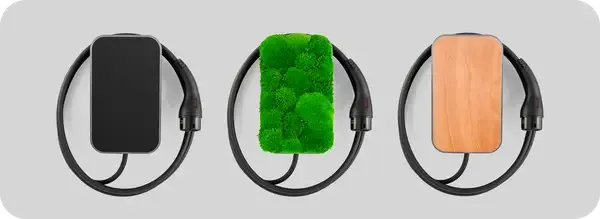
- selectable cover plate: metal, plastic or wood
Deye EV chargers
The ideal choice if you use, or plan to use, a Deye hybrid inverter and battery storage.
- 11 kW and 22 kW models
- single- and three-phase connection
- IP66 protection class
- operating temperature −40 °C to +55 °C
- built-in 6 mA DC leakage protection
- LoRa connection to the inverter
- automatic charging from solar surplus
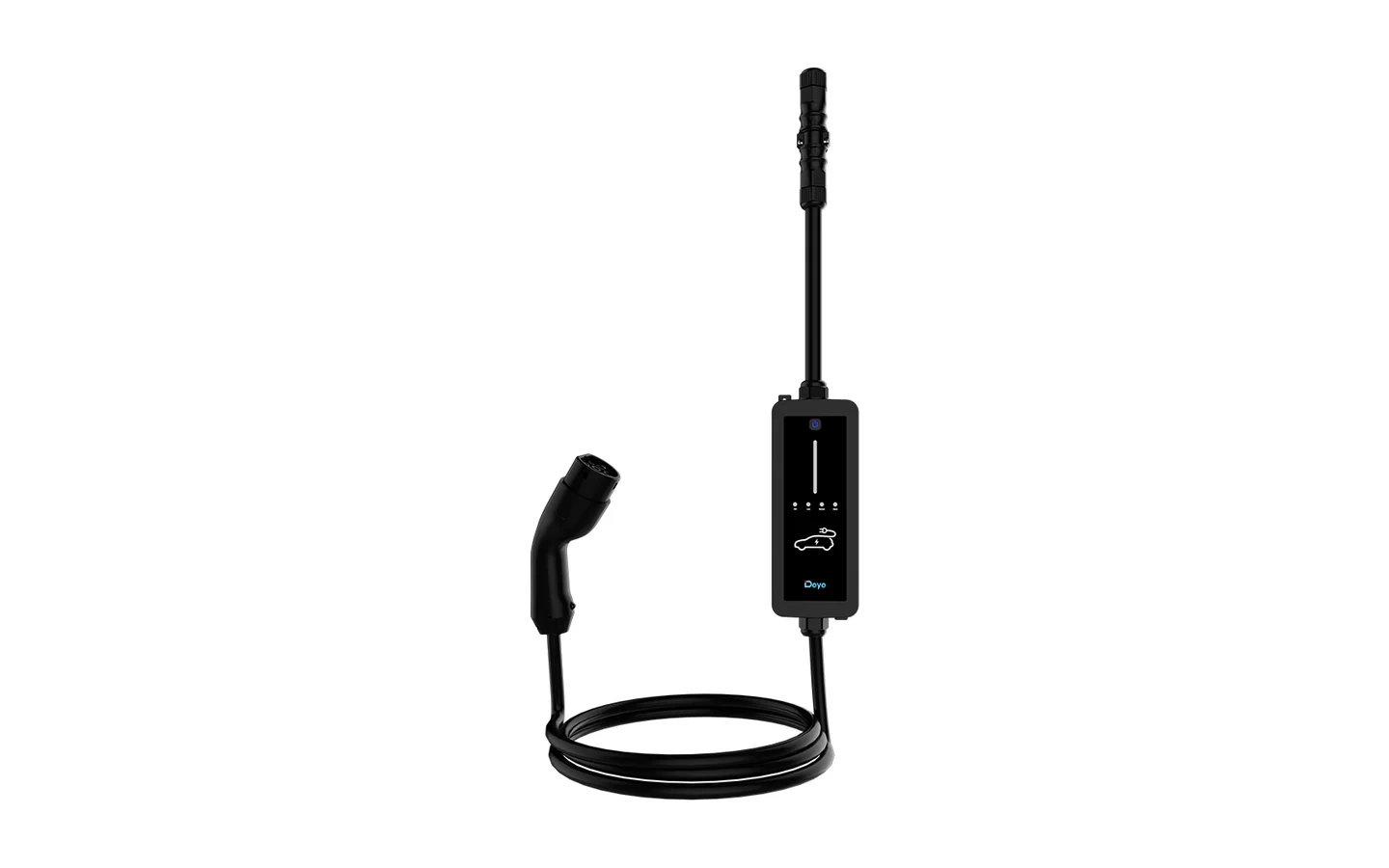
There are two Deye charger models. The data comes from the manufacturer’s official product page.
| Item | SUN-EVSE11K01-EU-AC | SUN-EVSE22K01-EU-AC |
|---|---|---|
| Power | 11 kW | 22 kW three-phase, 7 kW single-phase |
| Input current | 16 A | 32 A |
| Phases | 3L+N+PE | L+N+PE or 3L+N+PE |
| Connector | Type 2 | Type 2 |
| Cable length | 4.2 m | 4.2 m |
| Protection class | IP66 | IP66 |
| Operating temperature | −40 °C to +55 °C | −40 °C to +55 °C |
| Connectivity | LoRa, Wi-Fi, Bluetooth (BLE) | LoRa, Wi-Fi, Bluetooth (BLE) |
| Protections | Type B leakage and 6 mA DC fault protection | Type B leakage and 6 mA DC fault protection |
Where is the Deye charger sold in Estonia?
The Deye SUN-EVSE22K01-EU-AC 22 kW model is sold by Estonian web shops including Photopoint, OX.ee and MT Shop (Tallinn). We are not a representative of these sellers, and prices and availability change, so check them on the seller’s page. For the availability of the 11 kW model in Estonia, ask us.
If you want us to choose a suitable charger and install it for you, ask for a quote.
How much does EV charger installation cost?
Charger installation costs €1,500 + VAT on a wall and €1,800 + VAT on a post. The final price depends on the factors below.
The prices shown are base prices for a typical private house installation. Wall-mounted installation costs €1,500 (+ VAT) and post-mounted €1,800 (+ VAT). The final price is affected most by:
- the distance from the electrical panel to the charger and the cable length;
- the cable routing method (surface, conduit, underground);
- the charger power and the size of the main fuse;
- whether dynamic load management is needed;
- whether the charger is connected to solar panels;
- whether a post or wall mount is installed.
Before starting work we check that the electrical installation complies and prepare a transparent quote.
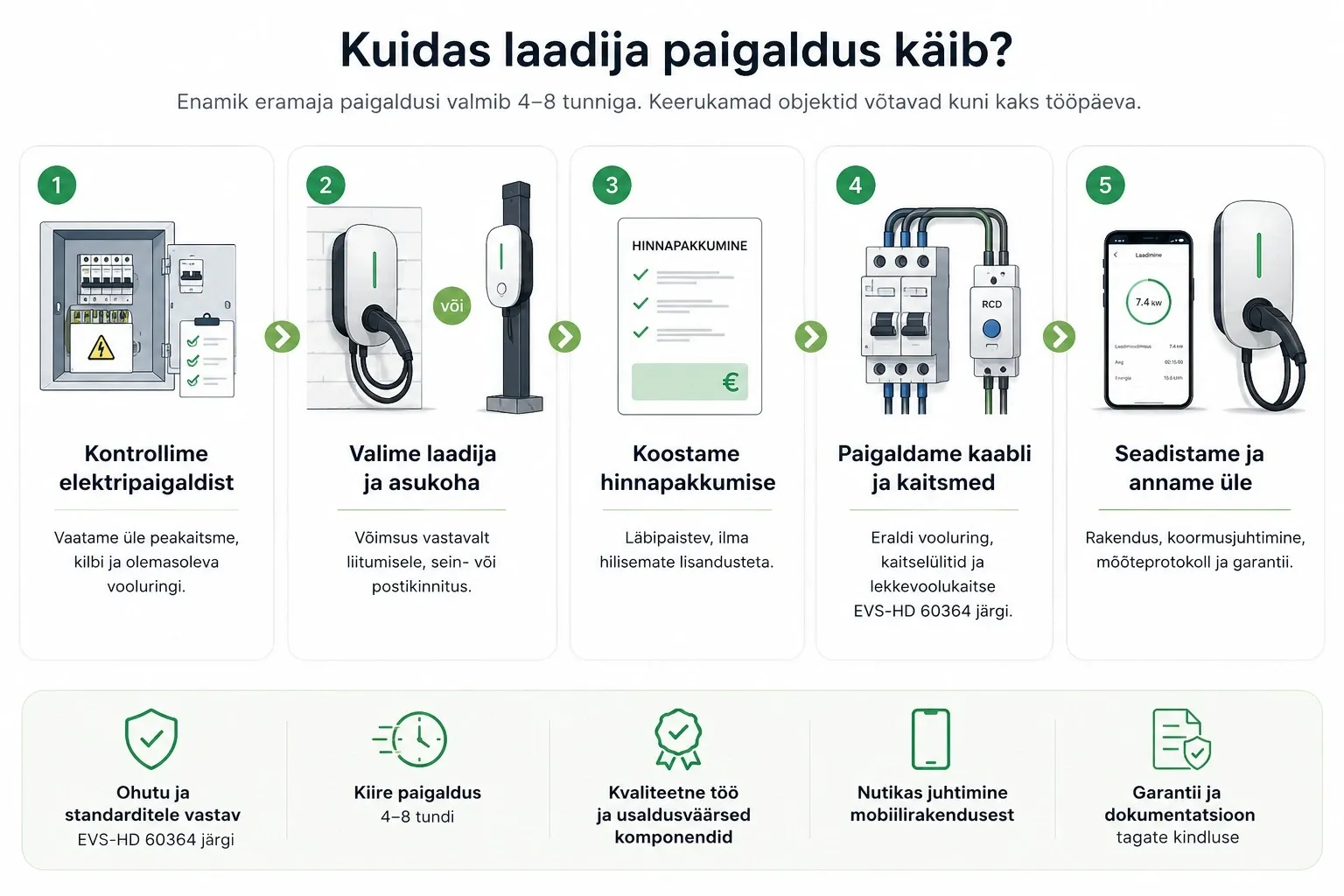
How does EV charger installation work?
Most private-house installations are done in 4–8 hours. More complex sites take up to two working days.
- We check the electrical installation We review the main fuse, the panel and the existing circuit.
- We choose the charger and location Power to match the connection, wall or post mount.
- We prepare a quote Transparent, with no later extras.
- We install the cable and fuses Dedicated circuit, circuit breakers and residual current protection according to EVS-HD 60364.
- We configure and hand over App, load management, measurement protocol and warranty.
EV charger installation across Estonia
We install EV chargers across Estonia, including Tallinn, Tartu, Pärnu and Narva.
We install new chargers as well as upgrade existing charging solutions.
Summary
- The base price for EV charger installation is €1,500–1,800 + VAT
- An 11 kW charger suits most private houses
- Installation takes 4–8 hours
- VOOL fits when you need OCPP, Deye when you use a Deye inverter
Public and semi-public EV charging solutions
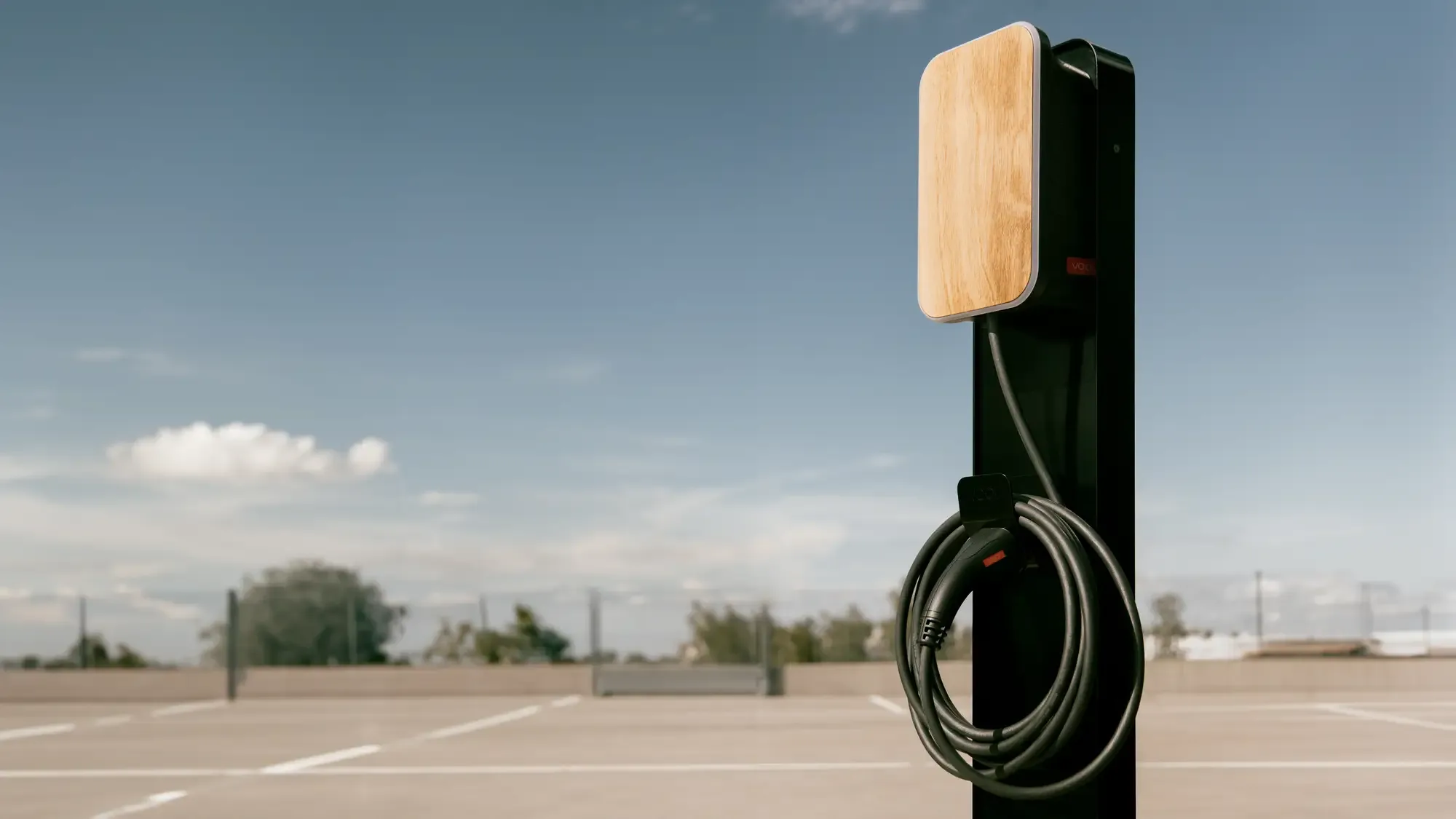
As electric car use grows, charging is becoming more and more important for businesses, housing associations and public places too. Amper ja Volt offers public and semi-public EV charging point solutions that suit car parks, commercial premises, office buildings, accommodation providers and apartment buildings.
A semi-public charging point lets you offer charging to a specific group of users, for example a company’s employees, customers or the residents of an apartment building.
A public charging station is a suitable solution for places where different EV users need charging.
Where are public and semi-public chargers used?
An EV charging point suits, for example:
- company and office car parks
- housing associations and new developments
- hotels, restaurants and service locations
- shopping centres and public car parks
A complete charging solution for businesses
We help you choose the right charger according to how it will be used and what your electrical grid allows. The solution can include charger selection, electrical work, installation, configuration and smart energy management.
Our aim is a reliable EV charging solution that is convenient to use for the business and for the people who use the charger.
Why choose Amper ja Volt Solarworks?
Over 14 years of experience in electrical work, 8 of them in solar. MTR registration no. TEL003912.
- Official VOOL installer
- Over 14 years of experience in electrical work
- Certified electrical installations
- Professional design and installation
- High-quality VOOL and Deye chargers
- Smart solutions together with solar panels and battery storage
- Warranty on installation and completed work
Frequently asked questions
Does a 22 kW charger always charge at 22 kW?
No. The maximum charging speed depends on the car’s built-in AC charger. If the car supports charging up to 11 kW, it will use at most 11 kW even from a 22 kW charger.
Can an EV charger be used with solar panels?
Yes. VOOL and Deye chargers can charge the car automatically with the surplus produced by solar panels, reducing the amount of energy bought from the grid.
Does the charger need its own protection?
Yes. An EV charger is connected to a dedicated circuit and fitted with compliant circuit breakers and residual current protection according to the EVS-HD 60364 standards.
How long does charger installation take?
Most private-house installations are completed in 4–8 hours. For more complex sites, installation can take one to two working days.
Can the charger be upgraded to higher power later?
Yes. If a 22 kW charger is installed, it can be limited in software to, for example, 11 kW and later, when the electrical connection is increased, put into use at full power.